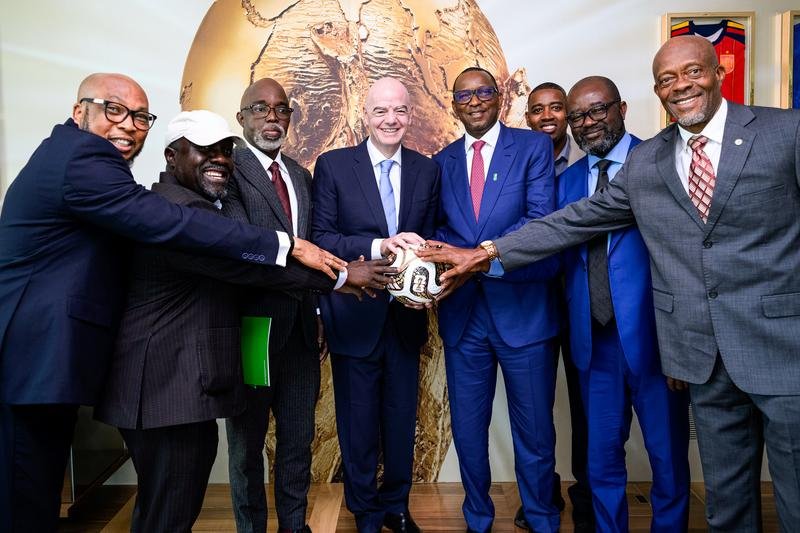
FIFA has accepted the resignations of Nigeria Football Federation President Ibrahim Musa Gusau, General Secretary Mohammed Sanusi and members of the Executive Committee, while backing continued talks on comprehensive reforms of Nigerian football.
The development leaves the NFF facing fresh reforms weeks before an election that had already gone through several stages, including the appointment of electoral committees, publication of a timetable and the opening of nominations.
The NFF said FIFA agreed to continue discussions with the Nigerian government, the NFF administration and the Confederation of African Football on a roadmap for short-, medium- and long-term reforms.
NFF President of the Board Shehu Dikko said the parties were already discussing the next stage.
“Mutual engagement among the National Sports Commission, the NFF administration and the Confederation of African Football is ongoing with FIFA on the comprehensive reforms of Nigeria football,” Dikko said.
The NFF Congress had already approved major changes to its governing framework at an Extraordinary General Assembly on March 23.
Congress approved amendments to the NFF Statutes, Electoral Code and Standing Orders. It also approved the staging of the 2026 Elective Congress in Lafia, Nasarawa State.
The revised Electoral Code was adopted by Congress on March 23 and came into force on March 24.
The revised electoral structure provides for 108 Congress delegates exercising 54 votes. The 36 state football associations and the Federal Capital Territory hold 37 of those votes, with the remaining votes allocated to other football constituencies.
The NFF subsequently inaugurated its electoral committees and published a timetable for the election.
Congress initially fixed September 26 for the Elective Congress before the date was moved to September 27.
The timetable set August 12 as the deadline for nominations, followed by screening from August 27 to 30, publication of cleared candidates on August 31 and an appeals process in September.
However, the process was suspended on August 27 following the resignations. The NFF said a “fresh electoral process” would begin after reforms carried out in consultation with FIFA and CAF.
According to a lawyer familiar with the NFF Statutes and football governance who does not wish to be named, ‘’the phrase ‘fresh electoral process’ does not by itself cancel the rules approved by Congress in March.”
“If the NFF restarts the election under the existing framework, those rules would continue to govern the process. Changes to eligibility, Congress composition, voting rights, nomination procedures or the powers of electoral bodies would require approval under the NFF’s constitutional framework,” the lawyer further said.
President Bola Tinubu had called for changes covering governance, administration, stakeholder representation, development pathways, domestic competitions and accountability across Nigerian football.
“The reform must respond to a longstanding need to strengthen governance, administration, stakeholder representation, development pathways, domestic competitions and accountability across Nigerian football,” Tinubu said.
FIFA has not announced a replacement Electoral Code or a new election date. Its confirmed position is that discussions on the reform roadmap will continue with the Nigerian government, the NFF administration and CAF.
The administrative changes have also extended to the domestic leagues. Following the resignations, the NFF directed the chairmen, directors and chief executive officers of the NPFL, NNL, NWFL and Nationwide League One to hand over administrative duties to their respective chief operating officers.